Hospital Admission at the Bristol Royal Infirmary
This post documents my personal experience as an inpatient at Bristol Royal Infirmary (BRI), alongside supporting witness statements from individuals who observed aspects of my treatment at the time. It is written to record events as they occurred, to the best of my knowledge, and to preserve an accurate account of what I experienced while under hospital care.
This is not intended as harassment, intimidation, or defamation. It is a factual account of my own treatment and its impact on my health and wellbeing.
Admission and Initial Assessment
I was admitted to Bristol Royal Infirmary via ambulance and taken into A&E due to significant mobility issues, frequent falls, and an inability to walk unaided. At the time of admission, I required a wheelchair.
While in A&E, I was told by a doctor that if I was able to walk into A&E, I should be able to walk into his treatment room. This occurred despite my arrival by ambulance and visible mobility impairment. When attempting to move independently, I experienced multiple falls, which were observed by staff. I was then told all my my medical issues were soley down to my medical cannabis perscription, something that is prescribed by a GMC certified doctor for people suffering from conditions that two or more treatment options have not worked on.
Following assessment, neurological concerns were identified after reflex testing, and I was admitted as an inpatient.
Inpatient Stay and Medication Issues
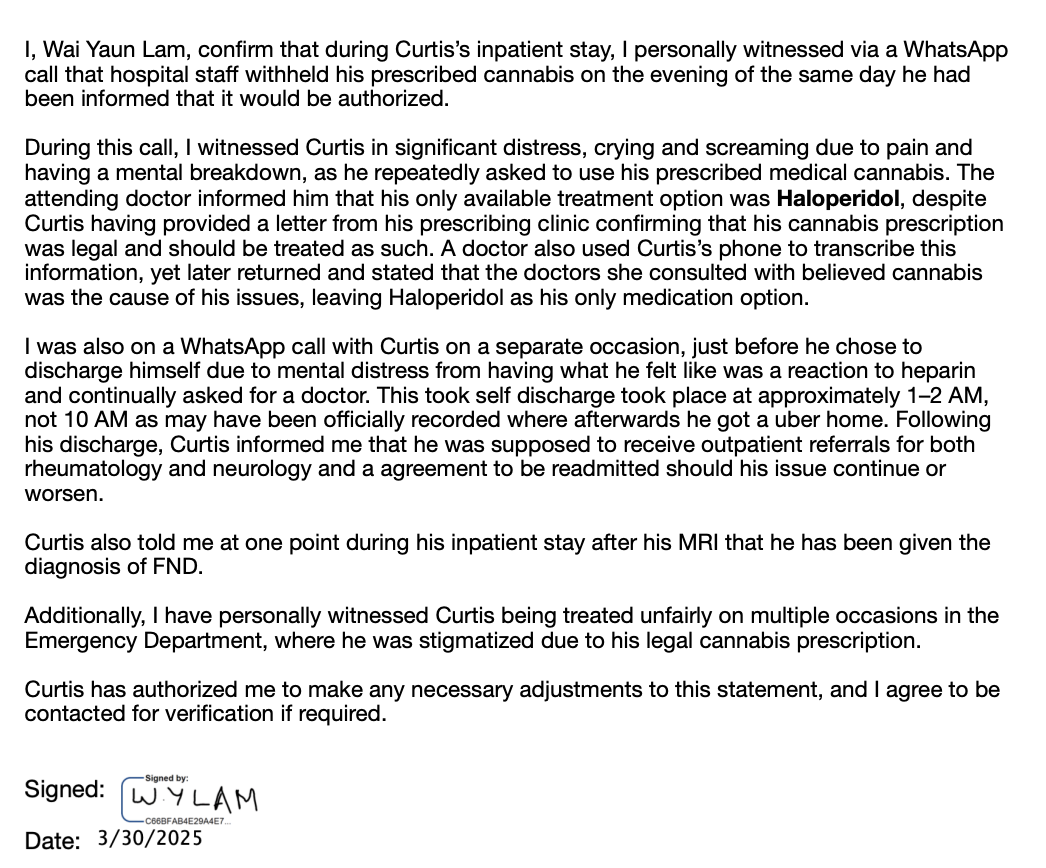
During my inpatient stay, I was moved between multiple temporary wards before being placed in a shared ward. Shortly after admission, my prescribed medical cannabis, legally prescribed by a specialist clinic, was confiscated and secured by the hospital. I was not permitted to access it despite repeated assurances over several days that it would be reviewed and authorised.
I remained without access to this medication for approximately four days. During this period, I experienced escalating pain, distress, and PTSD symptoms, which were exacerbated by the ward environment and the sudden withdrawal of a medication I use daily to manage my condition.
During an acute episode of distress, I was informed that haloperidol would be administered. This was later changed in the documentation to a benzodiazepine. Subsequently, I queried why haloperidol had been proposed instead of continuing my prescribed medication or offering a less severe alternative earlier. Later documentation stated that lorazepam had been offered, which did not reflect my recollection of events at the time.
PALS Involvement and Medication Access
Following intervention by a PALS officer, access to my prescribed medical cannabis was restored. I was informed that the presence of PALS had prompted a reassessment of the situation.
After my medication was returned, the pharmacy team discussed documenting it formally and advised that I should be provided with a lockbox key to maintain control of my prescription and prevent access by other patients. When I later requested this key, a member of nursing staff refused and responded dismissively.
Clinical Concerns and Discharge
Over the course of approximately two weeks, I remained largely bedbound, with limited daily review and ongoing pain. An MRI was eventually conducted and returned without findings, despite my repeated concerns relating to muscular symptoms, which MRI imaging does not necessarily detect.
On one night, I was administered an injection despite having previously reported an adverse reaction to that medication. I again experienced a reaction and reported difficulty breathing. Despite requesting medical review, I did not see a doctor for several hours.
At this point, I no longer felt safe on the ward and chose to self-discharge. I was informed by the doctor on duty that referrals to neurology and rheumatology would be made, and that I could be readmitted should my condition worsen. These arrangements were not reflected in subsequent records, and I did not receive follow-up care.
Subsequent Attendance and Ongoing Concerns
When I later returned to A&E seeking further care, I was met with hostility and raised voices. I have since been asked to remove footage relating to this interaction.
Supporting Statements
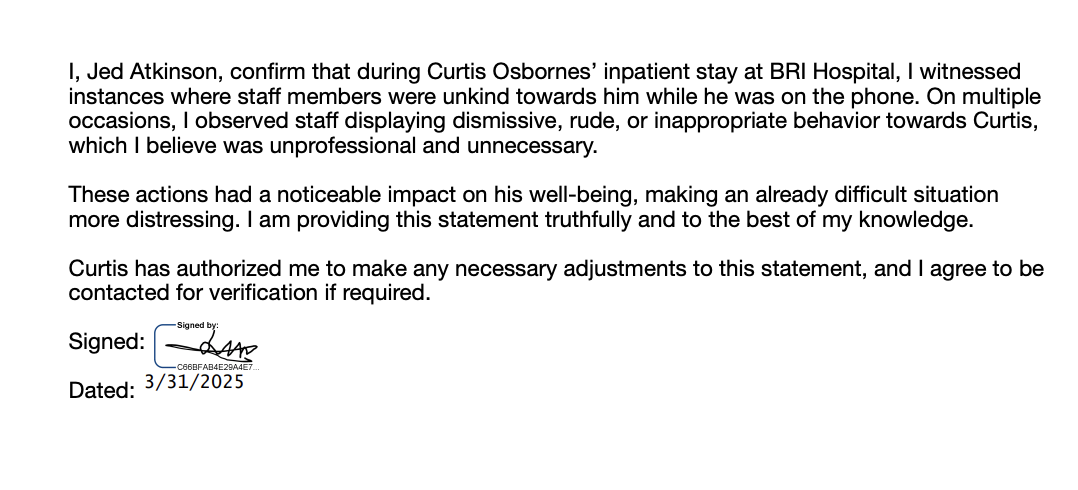
Included alongside this account are signed statements from individuals who witnessed aspects of my treatment during my inpatient stay and subsequent attendances. These statements were provided voluntarily and reflect the witnesses’ own observations.
Purpose of Publication
I am publishing this account to ensure that my experience is accurately documented and preserved. Where institutional records differ from my recollection, this post exists to provide context and balance.
I recognise that I am not a perfect patient and that I suffer with many neurodivergent tendecies. However, none of those factors justify dismissive treatment, withdrawal of prescribed medication without explanation, or prolonged distress without appropriate support.
This account reflects my lived experience. It is shared so that it cannot be erased.